The “tolerance” movement of the 90’s that told everyone “you don’t have to like or accept or respect everyone, just tolerate their existence” was a total failure, and will always be a total failure, because it did not address any base problems or issues.
Just because a man doesn’t call me a faggot to my face anymore doesn’t mean he still isn’t a homophobe that privately thinks I should be stoned to death. You’re not addressing the problem, you’re literally ignoring it. It doesn’t even mean that, privately, I still won’t get beaten or called slurs because hey it’s out of the public eye. As long as it looks like I’m being tolerated then it’s all cool right?
All it did was just move it to the shadows. Let people continue their bigotry behind closed doors so that when there wasn’t societal pressure to keep it hidden, like, say when a President is openly bigoted and shouts at rallies that “PC has gone mad and we can’t say what we think,” suddenly it’s all back in the open again. Hate crimes go up, violence and slurs and open hatred start becoming a norm again. Nazis might say lead torch lit rallies to synagogues, mosques, and black churches.
All the tolerance movement was, was a way for White cishet liberals to not have to think difficult thoughts on race, gender, sexuality, or religion. But once that veil of “tolerance” came off, suddenly they are aghast at all these bigotted people around them. Just because you didn’t want to see it or think about doesn’t make it go away. Address the real problems and maybe, in time, it finally will. You don’t heal by ignoring the disease.
Oh hey, this is relevant again.
Sorry to jump on your post but I used to remember being mad about this when I was a lot more conservative.
I didn’t know gay people even existed until I was fourteen, in the mid 2000s. Ripples of this movement were going around even then, mixed in with a really confusing slurry of anger in post-9/11 America. But you still got people trying to press the tolerance ideal with the exception of “oh right except for these guys.”
Tolerance movement meant I couldn’t even TALK to the people I was being told I was supposed to reject and not be like, for fear my stances (at the time) were too non-baseline and I’d offend them just by existing, or they’d offend me just by existing.
So you were supposed to keep this sort of tense utter silence in a sort of don’t ask don’t tell at all times for anything and everything. Perish the thought you made Muslim friends. Or Gay friends.
Which….ironically enough was what made me think both of us were in the same camp by not having a lukewarm middle option available to ether of us. We just…were these things.
But was probably pretty harmful for both of us because we never learned how to talk to one another except in open defiance of that unspoken rule not to judge or conform to any preexisting boxes that might preclude a position that led to judgment.
So we rebelled in having those cross-faction friendships that the tolerance movement would have said were great on the surface, while lecturing us for being in such a dangerous position of potential judgment. And fourteen year old me noticed this was because they wanted the picture of tolerance but not the spread and sharing of ideas or grievances.
Tolerance was not Community.
And most people excelled at being tolerant by coincidentally hanging out with people just like them, with whom they could talk up how they were nice to this stranger in passing.
Which I saw in my church. But also saw in my College later, and in fandom communities even later.
We still have ripples of that going around close to twenty years later. The echoes of the echoes of the echoes—like those people who came to your door this year for Halloween in the knock off of the knock off of the knock off Jack Sparrow pirate costumes.
So now not only do you have the fanatical gross people who hated being told to shut up about their racist opionions being extremely loud thinking they were part of some stifled and oppressed majority all along, but the people who were raised in that false sense of gentility and non-commitment are very very quietly appalled and that’s not helping.
You’re never going to tic all the boxes just right.
You’re going to have bits of you that stand out or things you do which aren’t great.
Not talking about them or ignoring them just means you never fix the things you do that are awful, or how to articulate the parts of your that just simply are. You end up living this great big lie of telling yourself you’re above reproach because you took this impossible wise “middle path”.
There are people out there who are being oppressed.
There always are.
And there are always people who sit by and do nothing. Whether out of fear or out of a desire to save face.
This was a problem in the forties and it’s a problem now, because people are people. And all that we have has not succeeded at making us better as a common race.
But the appearance of tolerance and morality with no substance or action is something that only serves you.
The Tolerance movement as it existed in the Nineties and after was extremely selfish in the way it came to be practiced, and people suffered for it.
It’s our responsibility to learn from that and do something better to alleviate suffering at the cost of ego, and to build communities out of mixed materials.
What Europe learned in 1600s is repeated right now:
Tolerance is not equality
Six cats, two dogs, a horse and a rat that was running along a fence, obviously up to no good.
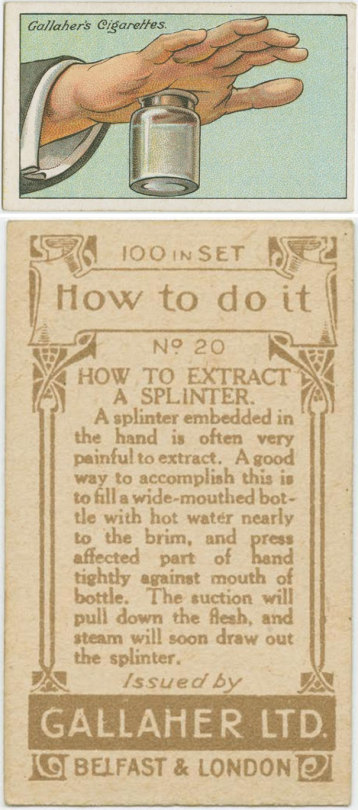
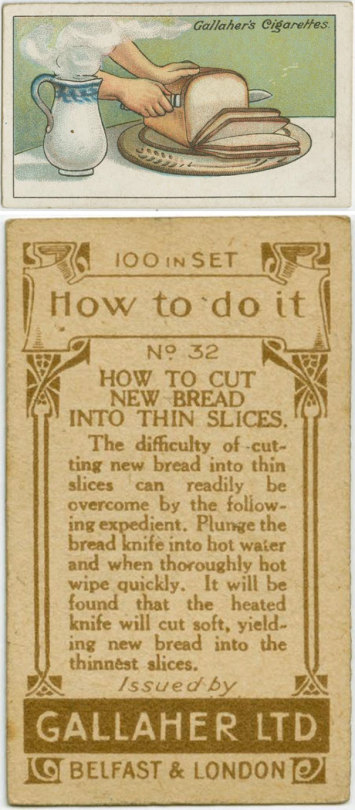
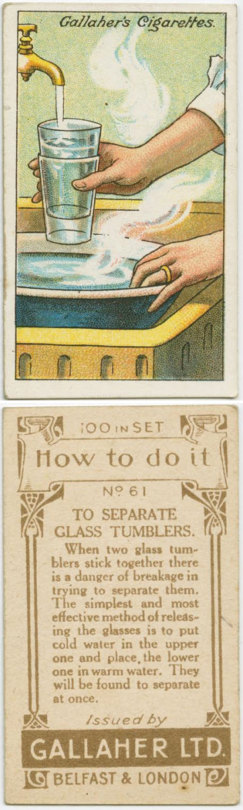
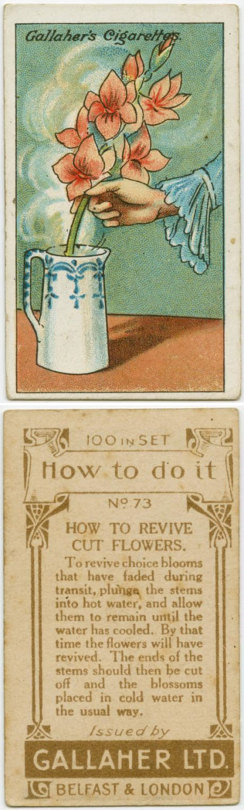
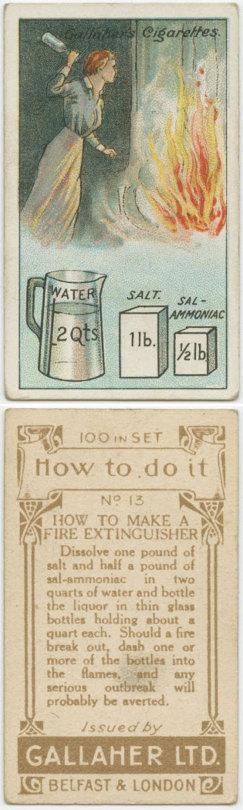
People don’t often look back on the early 1900’s for advice, but what if we could actually learn something from the Lost Generation? The New York Public Library has digitized 100 “how to do it” cards found in cigarette boxes over 100 years ago, and the tips they give are so practical that millennials reading this might want to take notes.
Back in the day, cigarette cards were popular collectibles included in every pack, and displayed photos of celebrities, advertisements, and more. Gallaher cigarettes, a UK-founded tobacco company that was once the largest in the world, decided to print a series of helpful how-to’s on their cards, which ranged from mundane tasks (boiling potatoes) to unlikely scenarios (stopping a runaway horse). Most of them are insanely clever, though, like how to make a fire extinguisher at home. Who even knew you could do that?
The entire set of life hacks is now part of the NYPL’s George Arents Collection. Check out some of the cleverest ones we could find below. You never know when you’ll have to clean real lace!
like, u know there is a degree of moderation there, right? someone has to order the books to stock in the library. a library that lets any old creep stash their hastily scribbled shota pwp in between the shelves is a library that’s going to be shut down p quick. by the police. for providing ppl with child porn. (and yes if a picture of a tree or a description of a tree can make someone experience a tree, then the same can be said about a picture or description of a child in a sexual situation ffs)
I mean there’s like a million other logistical differences, and idk who checks erotica out of a library, but hey ppl can be wild abt these things
Hooboy. Well, as a librarian who has worked in many varieties of libraries, let me… try to… respond to this from a library and librarian perspective.
1) It is true that libraries have a process to go through for accepting materials, and that there is a degree of selectivity involved–this is because libraries have limited budgets, limited physical space, and limited staff to process and manage materials.
So, yes, any random junk written and left in the library would be thrown out. Not because the library would be concerned about its liability if anyone should see it; because we like to keep the library clean and organized, and leaving stuff on the shelf is not how we add things to the collection (how would they get CATALOGUED and LABELED???) And, of course, any adult attempting to show pornography (or, say, themselves) to actual children would be Removed From The Library because this would involve actual children being harmed by an actual adult in direct contact with them. Police do not shut down the libraries where this happens. They arrest the people harming the children.
Meanwhile, libraries spend VAST SUMS OF MONEY and ENDLESS STAFF HOURS to keep copies of Fifty Shades of Gray on the shelves where children actually can find them quite readily (and have them checked out on their library cards if mom’s has too many fines). Same with Last Tango in Paris and Flowers in the Attic and Year’s Best Erotica collections. (And Bibles, which get stolen at a ridiculous pace. I don’t know why, we were just forever having to order more of them.)
In an online space, which has effectively unlimited space, where adding new material costs nothing, and where the process of organizing that material and making it available is fully automated and what labor is involved is taken on by the contributing author, literally none of those constraints apply, so more content is more content! It’s catalogued and labeled as soon as it’s posted! It cannot be misshelved. Perfect!
2) This is not to say that no physical library has handwritten erotica in its collection somewhere. Many, many libraries collect rare local works such as self-published zines, and unique items like the personal papers of notable people (San Jose State University, for instance, holds the papers of the Kensington Ladies’ Erotica Society; The University of Iowa Zine Collection includes fanfic zines with erotic content; UCLA has the personal papers of Anais Nin), and doubtless some of these zines and personal papers include erotica. Because this handwritten material would be unique and its value would be presumed to lie mainly in the fact of its authorship, it would be properly collected, not in a library, but in an archive or special collection, where some archivist would dutifully folder it and make a note of what it was so future visitors to the collection could readily access it.
The main goal there would be to protect the material, not the person who might potentially view the material.
I worked in a public library which had an extensive collection of Playboy on microfilm, for instance. We kept it behind a desk where it had to be requested and checked out with a library card before it could be viewed. This was partly to prevent children viewing material inappropriate for their age–just as, say, the AO3 clearly marks adult material as such–but mainly to prevent vandalism of the material by people who disapproved of it. Several of the images on the film had been damaged by people trying to scratch them out; for the safety of the microfilm, we restricted access to it. This is also why the AO3 doesn’t allow people who dislike a fic to force it to be taken down.
This is also why most libraries celebrate Banned Books Week by eagerly higlighting works which people have ATTEMPTED to force to be removed from libraries–including work like Lolita, which is read by many as a titillating pedophile love affair. Librarians are not celebrating Lolita. They are celebrating the principle that they will not be stopped from collecting materials of interest and making them available to readers.
3) From your description of a library where children can freely access anything on the shelves, you seem to have only one conception of a library–a public library with open stacks, or perhaps a school library. There are, in fact, many kinds of libraries, with academic libraries being the most obvious foil to your description.
In an academic or university library, all authorized users of the library are adults who take adult responsibility for what they find in the library, much like when adult internet users indicate on a website that they are choosing to view adult content.
When I worked in a university library, I asked one of the librarians what do when a guy was sitting at a computer very obviously watching porn while a young woman, sitting next to him doing something text-based, seemed like she might be uncomfortable. I was told in no uncertain terms that the library’s policy was to relocate the person who was uncomfortable. The library was a repository of information and a place to access information: any kind of information, including the erotic. Under no circumstances would we curtail a library user’s access to that information.
(Unless he got his own actual dick out where people could see it, then we could call the campus police. Because, again: actual humans directly involved.)
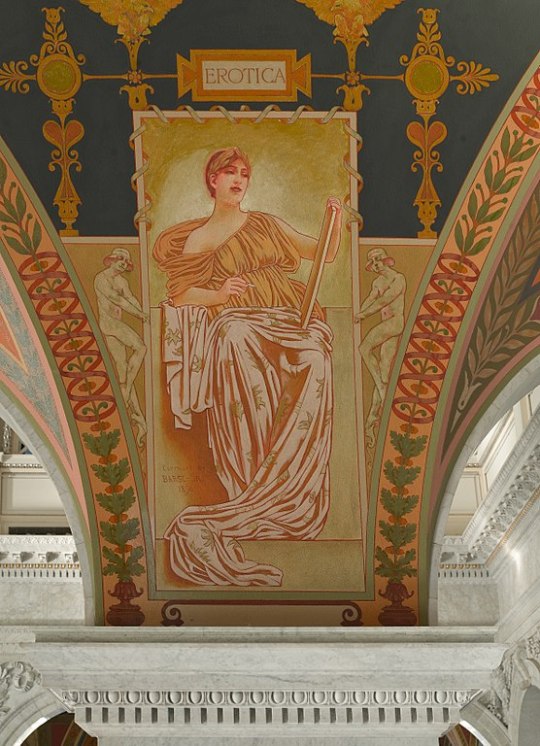
Duke University Library Erotica Collection, 1940s-1960s (”An archive of original illustrations, sketchbooks, and erotic stories, depicting transgressive sex acts including (but not limited to) lesbian and heterosexual sex, incest, pedophilia, sadomassochistic behavior, and copulation with objects as varied as sex toys, produce, and household appliances. The stories and illustrations appear to be the work of a single individual, with nearly all narrative told from a female’s point of view. Also includes some amateur pornographic photography and magazine clippings.”)












 Asknotbug's Tumblr Backup
